Desert Schools Credit Union let me create a password that contains characters that are not letters or numbers, but it won't let me login with that password.

Desert Schools Credit Union let me create a password that contains characters that are not letters or numbers, but it won't let me login with that password.
what does this mean i feel abused pic.twitter.com/uhvhukZZaF
— lauren sanderson (@laurenthellama) November 15, 2013
As a fundamental principle in software system security, it is considered wrong to expose anything about protected data in a system in the error messages that are returned to those who are not authorized to access that data.
For example, if one enters an incorrect username and/or password, you do not tell them whether the username or password is incorrect. Confirming that a username exists is useful information to someone who is trying to gain unauthorized access: it allows them to narrow their attack to a known username and/or combine the username with other info to aid in guessing or otherwise gaining access to the password. Such information is useful in social engineering.
GIVEN that not disclosing information to the unauthorized in error messages is a practice that is expected of any competent web application developer
AND that Healthcare.gov is a system many are required by law to use
AND that Healthcare.gov contains private information,
THEN let's take a look at what we get from Healthcare.gov :


I found this old bug report in the Mozilla bug database. Is exposing liars a bug or a feature? ;)
Bug 330884 - When different users on one system choose to save or not save passwords for sites, any other user can see sites they not only saved passwords for but can also see what other users have been saving/never saving passwords for.
naomirocks 2006-03-17 15:48:21 PST
User-Agent: Mozilla/4.0 (compatible; MSIE 7.0; Windows NT 5.1; SV1; .NET CLR 1.1.4322)
Build Identifier: Mozilla/5.0 (Windows; U; Windows NT 5.1; en-US; rv:1.8.0.1) Gecko/20060111 Firefox/1.5.0.1
This privacy flaw has caused my fiancé and I to break-up after having dated for 5 years.
Basically, we share one computer but under separate Windows XP user accounts. We both use Mozilla Firefox -- well, he used to use it more than I do but now we don't really use it. The privacy flaw is this: when he went to log-in under his dating sites (jdate.com, swinglifestyle.com, adultfriendfinder.com, etc.), Mozilla promptly asks whether or not he'd like Firefox to save the passwords for him. He chose never, obviously. However, when he logged off his user account, and I logged onto my Windows XP account X amount of days later, I decided to use Firefox because hey -- it loaded everything much more efficiently, was better to work on with website designs and is a lot more stable than IE7beta2.
Firefox prompted whether or not I'd like it to save my password for logging into my website. I chose never and changed my mind. I went into the Password Manager to change the saved password option from Never to Always and that's when I saw all these other sites that had been selected as "Never Save Password." Of course, those were sites I had never visited or could ever dream of visiting.
Then I realized who, how and what... and sh*t hit the fan. Your browser does not efficiently respect the privacy of different users for one system.
Reproducible: Always
@throg tweets: I tried to change my password to "correcthorsebatterystaple" and got this error message.

Better pick a password that is easier for computers to guess.
In case you don't know why someone would pick such a password, check out this xkcd comic:

Trying to order ink from the HP Home and Home Office Store to which the HP printer driver software on my computer took me, I get the following:
You tried to create a new account using an e-mail address that matches an existing account. To continue your checkout process, do not fill in the password fields.I've never ordered anything from an HP online store. How can my e-mail address match an existing account? If I continue the checkout process without filling in the password fields, will this order be associated with some existing account without any credential verification? Or will it not be associated with any account? Will I be able to access this order if there is no account associated with it?
What is a more secure way to secure people's data on your website than the typical username and password pairing?
Someone at UPS seems to think an answer to a stupid question is better. These aren't just any stupid questions. These are question that are likely answerable by anyone who knows you. If you pick the right question, there's a good chance that you've even posted the answer to the question on your blog, on Facebook, or even Twitter. So, what is a stupid question? Take a look:

No, these aren't the so-called "security questions" that are used in addition to a username and password pair. This question and answer is being used where a password would typically be found.
All that is needed to access an account is an email address and the answer to a question.


I try to reset the password for a local Windows Server account and get the following warning dialog.

It warns that resetting the password might cause IRREVERSIBLE LOSS of "certain information". If the information that will be lost is certain, why doesn't this warning tell me what information will be lost and what won't be lost?
And what is this stuff about a disk? Who creates password reset disks for every user of a server? I haven't. Should I?
Wanting additional information, I click the Help button. This opens a local help document that explains what data will no longer be acceptable. However, even this refers to "some types of information" and gives an "including" list. It doesn't give a full inclusive list. Or if this list is inclusive, that isn't clear from the help document.
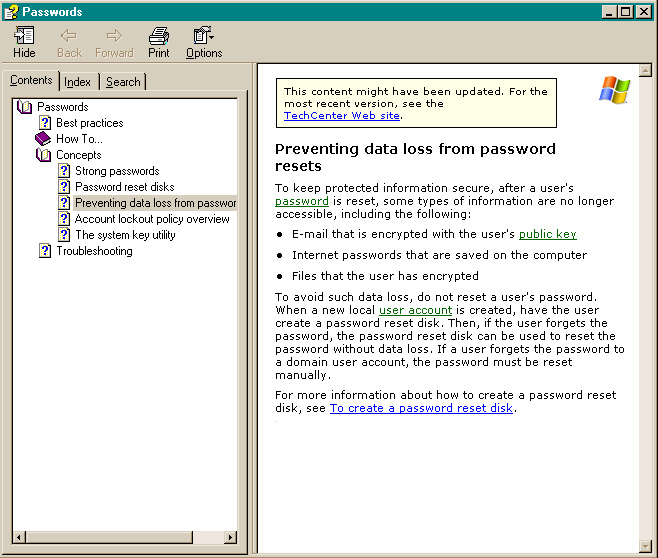
If you are going to tell me that my actions might cause damage to "certain information", please have the courtesy to give me sufficient details to make an informed decision.

It seems the nice folks at Gamestop.com are giving those seeking unauthorized access half the information needed to access an account.
It said this yesterday too.

If I don't change my password, will it forever expire later "today"? ;)
Michael F reports:
Got this using my Username and Password, and an updated one from the site.
So what is the Error?

osma: updating my computer. apparently one of many updates has an issue, but which one? #packagekit #fail

Security features like this can be useful in protecting computers from malware but ONLY IF the user is given sufficient information to make intelligent decisions.
Reported by James Grenning:
Chase Healthcare savings Account (HSA) management website.


I got the above screen after failing to login to my Meetup account to RSVP for a meeting.
As a user, I like that it tells me that I used the correct email address but wrong password.
However, this system has just verified information without authentication. It tells me that a valid user email address was used. This information could be helpful to someone trying to gain unauthorized access.
Now, in this case, I don't think disclosing that email accounts exist is a huge deal. This is a social networking site. This is not a banking system. This is not a medical records system. It is not an interface to access private information. Meetup profiles are public and searchable on the web -- although not email addresses. I say no problem in the context of this site.
For other systems, giving non-authenticated people information that narrows down access credential options could be a huge security problem.
Tweeted by MatTipton.

Wow! Don't put your password on a sticky note under the keyboard when you can hide it in client-side Javascript code. This may meet the technical requirements given to the developer but it fails to meet the expectations, and purpose, of access control systems.


 Comment
 5 Comments